- The Cada Global Newsletter
- Posts
- Building Resilience | Cada Global Newsletter - December 2025
Building Resilience | Cada Global Newsletter - December 2025
Welcome to this month's newsletter for Followers and Users of Cada Global software

Dave Adamson
December 01, 2025


The newsletter features popular, created, and curated content, as well as occasional updates on tools being used or evaluated, and the Cada Global application, GetRiskManager.
Please share this information with others if you feel they would benefit from it.
You can also read this and previous newsletters; others can subscribe by following the subscribe link below.
This Month
📝 Newly created content: Building Resilience: Lessons from the Connor-Davidson Scale
📝 Trending created content: The Balanced Scorecard: How to Align Strategy with Action
📝 Trending curated content: New in SparkToro: Take Action combines real audience data with LLM magic to give you actionable marketing takeaways
Cada Global Sofwtare

Building Resilience: Lessons from the Connor-Davidson Scale
Uncertainty is no longer a phase; it is the baseline. From supply chain disruptions to rapid technological shifts, leaders and employees alike are operating in a state of constant flux.
For years, "resilience" has been a corporate buzzword, often misused as a synonym for endurance or simply "toughing it out." However, psychological research offers a much more nuanced definition. Resilience is not merely surviving the storm; it is the ability to adapt, recover, and even thrive amidst adversity.
One of the most robust tools for understanding this trait is the Connor-Davidson Resilience Scale (CD-RISC). By unpacking the components of this scale, we can move beyond platitudes and implement research-backed strategies to build psychological and organisational fortitude.

This is a long article, so you may wish to listen instead (AI-generated audio).
Why Resilience Matters Now More Than Ever
The past few years have tested organisational resilience like never before. From pandemic disruptions to economic volatility, from supply chain crises to the rapid acceleration of AI and technological change, businesses face an unprecedented pace of uncertainty. Leaders who once operated with five-year strategic plans now find themselves recalibrating quarterly, sometimes monthly.
Yet amid this turbulence, some individuals and organisations don't just survive, they thrive. They adapt, learn, and emerge stronger from each challenge. What separates those who flourish from those who flounder? The answer lies in resilience: not as an innate trait that some people simply possess, but as a learnable set of skills and practices that can be systematically developed.
The Connor-Davidson Resilience Scale (CD-RISC) offers us a research-validated framework for understanding and building this critical capacity. By examining the lessons embedded in this widely-used psychological instrument, we can unlock practical, evidence-based strategies for developing both personal and organisational resilience; transforming how we face uncertainty and leveraging adversity as a catalyst for growth.
Understanding the Connor-Davidson Resilience Scale
Developed in 2003 by psychiatrist Kathryn Connor and researcher Jonathan Davidson, the CD-RISC emerged from a need to measure resilience in a clinically meaningful way. Unlike earlier measures, this 25-item self-report scale was designed to capture the multidimensional nature of resilience and, crucially, to measure change over time; making it valuable not just for assessment but for tracking the impact of resilience-building interventions.
The scale has since become one of the most widely used resilience measures worldwide, applied in clinical settings, academic research, military training, and increasingly in organisational contexts. It asks respondents to rate statements like "I am able to adapt to change” and "I tend to bounce back after illness or hardship" on a scale from not true at all to true nearly all the time.
The Five Pillars of Resilience
Research analysis of the CD-RISC reveals five interconnected factors that together constitute resilience:
1. Personal Competence and Tenacity
This factor captures the ability to persist through challenges, maintain high standards despite obstacles, and achieve goals even under difficult circumstances. It's about viewing yourself as capable and refusing to give up easily.
2. Trust in One's Instincts and Tolerance of Negative Affect
Resilient individuals can tolerate uncomfortable emotions without being overwhelmed by them. They trust their judgment, can handle unpleasant feelings, and maintain functioning even when under stress.
3. Positive Acceptance of Change and Secure Relationships
This dimension recognises that resilience isn't a solo endeavour. It involves both adaptability, seeing change as a natural part of life rather than a threat, and strong relationships that provide support during difficult times.
4. Control and Sense of Purpose
Resilient people believe their actions matter. They maintain a sense of agency even in challenging circumstances and are guided by clear goals and values that provide direction during chaos.
5. Spiritual Influences
This factor encompasses belief systems that provide meaning, whether religious faith, philosophical principles, or a sense of connection to something larger than oneself.
For modern leaders and organisations, this framework matters because it shifts resilience from a vague buzzword to a concrete set of capabilities that can be assessed, developed, and measured.
Building Personal Resilience: Individual-Level Strategies
The research is clear: competence breeds confidence, and confidence fuels resilience. Psychologist Albert Bandura's decades of work on self-efficacy demonstrates that our belief in our capabilities, built through actual accomplishments, is one of the strongest predictors of resilient behaviour.
The key is a strategic challenge. Rather than avoiding difficulty or jumping into overwhelming situations, resilient individuals seek out progressive challenges that stretch their abilities without breaking them. This is the "Goldilocks zone" of growth: hard enough to require real effort, achievable enough to succeed.
Practical application: Identify one area where you feel less confident. Break down a challenging goal in that area into smaller milestones. Achieve the first milestone, reflect on what you learned, then tackle the next. This creates a documented track record of overcoming difficulty that you can draw upon when facing future challenges.
Emotional Regulation: Working With, Not Against, Your Feelings
One of the most misunderstood aspects of resilience is emotional regulation. Resilience doesn't mean suppressing emotions or maintaining a false positivity. Instead, it involves developing the capacity to experience difficult emotions without being hijacked by them.
Neuroscience reveals that our stress response, the fight-flight-freeze mechanism, is designed for acute, physical threats. But in modern organisational life, this same response activates for psychological stressors: difficult conversations, financial pressures, or uncertainty about the future. The physiological reaction meant to help us escape a predator becomes counterproductive when triggered by an email.
Evidence-based practices for emotional regulation include:
Mindfulness meditation: Research shows that regular mindfulness practice actually changes brain structure, strengthening areas associated with emotional regulation and weakening connections that fuel anxiety.
Cognitive reframing: Examining and challenging unhelpful thought patterns. The difference between "This is a disaster" and "This is difficult, and I've handled difficult situations before" is profound.
Self-compassion: Kristin Neff's research demonstrates that treating yourself with the same kindness you'd offer a struggling friend significantly improves resilience and reduces anxiety.
The goal isn't to eliminate stress, that's impossible in any meaningful life or career, but to increase your capacity to remain functional and thoughtful even when stressed.
Cultivating Purpose: Your North Star in the Storm
Viktor Frankl, psychiatrist and Holocaust survivor, wrote in "Man's Search for Meaning" that those who survived the concentration camps were often not the physically strongest, but those who maintained a sense of purpose, a reason to endure. This observation has been validated by decades of subsequent research linking sense of purpose to resilience, wellbeing, and even physical health.
In organisational contexts, purpose serves as a stabilising force amid uncertainty. When market conditions shift or strategies change, a clear sense of why your work matters provides continuity and direction.
Reflection exercise: Write your personal mission statement. Complete these prompts:
The impact I want to have is...
The values that guide my decisions are...
Success, to me, means...
When facing difficult choices, I prioritise...
Review this regularly, especially during challenging times. Purpose doesn't eliminate difficulty, but it contextualises it within a larger framework of meaning.
The Power of Connection: Resilience as a Relational Practice
Despite the cultural myth of the lone resilient hero, research consistently shows that strong social connections are among the most powerful protective factors against adversity. The quality of our relationships, having people we can turn to for support, perspective, and practical help, significantly predicts how well we navigate challenges.
Yet many high-achieving professionals struggle to ask for help, viewing it as weakness rather than wisdom. This is a critical misconception. Resilient individuals recognise that seeking support is an active coping strategy, not a failure of self-sufficiency.
Building a resilience-supporting network doesn't require dozens of connections. Research suggests that even a handful of high-quality relationships can provide substantial protective benefits. Focus on relationships characterised by:
Mutual trust and confidentiality
Honest feedback and perspective-giving
Practical support during concrete challenges
Celebration of successes alongside support during struggles
Organisational Resilience: System-Level Strategies
While individual resilience is essential, placing the entire burden on individuals is both unfair and ineffective. Organisations themselves must be designed for resilience, creating systems and cultures that support rather than undermine human capacity to navigate uncertainty.
Psychological Safety: The Foundation of Organisational Resilience
Harvard professor Amy Edmondson's groundbreaking research on psychological safety reveals a paradox: the teams that report the most errors are often not the worst performers, but the best. In psychologically safe environments, people acknowledge mistakes, ask questions, and raise concerns without fear of punishment or humiliation. This enables rapid learning and adaptation, the essence of organisational resilience.
Psychological safety isn't about being nice or avoiding difficult conversations. It's about creating conditions where people can take interpersonal risks necessary for innovation and problem-solving.
Leaders can build psychological safety by:
Explicitly framing work as learning problems, not execution problems
Acknowledging their own fallibility and mistakes
Asking questions that demonstrate genuine curiosity
Responding to bad news with inquiry, not blame
Creating formal mechanisms for raising concerns
When organisations lack psychological safety, people hide problems until they become crises, avoid innovation due to failure risk, and disengage emotionally; all behaviours that destroy resilience.
Organisational Adaptability: Built-In Flexibility
Rigid organisations are fragile organisations. When circumstances change, and they always do, companies with inflexible structures, processes, and mindsets find themselves unable to respond effectively.
Peter Senge's concept of the "learning organisation" remains profoundly relevant. Resilient organisations are characterised by:
Decentralised decision-making: Empowering people closest to problems to solve them without requiring approval from distant headquarters
Experimental mindset: Treating strategies as hypotheses to be tested rather than plans to be executed perfectly
Feedback loops: Systems for quickly sensing changes in the environment and adjusting course
Cross-functional collaboration: Breaking down silos that prevent rapid information flow and integrated response
Companies that thrived during recent disruptions often shared this adaptability. They had cultivated the organisational muscle memory of pivoting; not as a panic response, but as a core capability.
Scenario planning is a practical tool for building adaptability. Rather than trying to predict the future, develop multiple plausible scenarios and plan responses for each. This mental rehearsal makes actual adaptation faster and more coordinated when change arrives.
Distributed Leadership: Resilience Through Empowerment
Traditional command-and-control leadership structures create brittleness. When authority and decision-making are concentrated at the top, the organisation can only respond as quickly as those few individuals can process information and make decisions.
Resilient organisations distribute leadership throughout the system. This doesn't mean eliminating hierarchy or accountability, but rather empowering teams and individuals to make decisions within clearly defined boundaries.
Research on high-reliability organisations, such as aircraft carriers, nuclear power plants, and emergency rooms, shows that these potentially dangerous environments maintain exceptional safety records partly through distributed expertise. The newest team member is empowered to stop a process if they notice a safety concern. Information flows quickly to those who need it, regardless of formal rank.
In business contexts, this might mean:
Clear decision-making frameworks specifying who can decide what
Investment in developing judgment and decision-making skills throughout the organisation
Rapid information sharing that ensures distributed decision-makers have the needed context
Tolerance for local variation in how common goals are achieved
Investing in Wellbeing: Resilience as Infrastructure
Organisations increasingly recognise employee wellbeing not as a perk but as infrastructure; a foundational element enabling performance and resilience. The return on investment is substantial: research links wellbeing programs to reduced absenteeism, improved productivity, lower healthcare costs, and crucially, increased organisational resilience during crises.
Effective well-being investment goes beyond superficial benefits:
Mental health support: Accessible counselling, therapy benefits, and destigmatization of mental health challenges
Sustainable work practices: Realistic workload management, protection of personal time, and recognition that burnout destroys rather than builds resilience
Skills development: Training in stress management, emotional regulation, and other resilience competencies
Environmental design: Physical and digital work environments that support rather than drain energy
The key insight: resilience isn't just about responding to crises. It's about creating sustainable conditions where people can maintain high performance over time without depleting themselves.
The Integration: When Personal and Organisational Resilience Align
The most powerful resilience emerges at the intersection of individual and organisational capacity. Resilient individuals in toxic systems burn out. Strong organisational systems with depleted individuals underperform. But when personal and organisational resilience reinforce each other, something remarkable happens.
Consider the ripple effect of resilient leaders. When a leader models healthy stress management, acknowledges struggles, seeks support appropriately, and maintains perspective during a crisis, they give permission for others to do the same. Leadership behaviour is the most powerful culture-shaping force in any organisation.
This creates a virtuous cycle: psychologically safe cultures enable individuals to develop resilience skills by practising them without excessive risk. Individuals with strong resilience competencies contribute to organisational adaptive capacity. The organisation becomes more resilient, which further supports individual development.
However, we must guard against "toxic resilience"; the expectation that people should endure unsustainable conditions through sheer mental toughness. True resilience recognises when systems need to change, not just when individuals need to cope better. Sometimes the most resilient response is advocating for systemic change or, in extreme cases, leaving an unhealthy environment.
From Theory to Practice: A Resilience Implementation Framework
Phase 1: Assessment—Establishing Your Baseline
You can't improve what you don't measure. Begin by establishing baselines:
Individual level: The CD-RISC or similar validated instruments can provide individuals with insight into their current resilience profile, highlighting both strengths and development areas.
Team level: Pulse surveys assessing psychological safety, stress levels, and confidence in ability to navigate challenges
Organisational level: Resilience audits examining structures, processes, and cultural patterns that either support or undermine adaptive capacity
The goal isn't judgment but clarity. Where are we strong? Where are we vulnerable? What patterns do we notice?
Phase 2: Development—Building Targeted Capabilities
With assessment data in hand, create targeted development strategies:
Individual plans: Each person identifies 2-3 specific resilience competencies to strengthen over the next 90 days. This might include establishing a mindfulness practice, building a peer support network, or deliberately taking on a stretch project to build competence in a new area.
Team initiatives: Teams work collectively on resilience capabilities. This might involve psychological safety workshops, establishing team norms around sustainable work practices, or creating peer coaching structures.
Organisational interventions: System-level changes to policies, processes, and cultural norms. This might include revised decision-making frameworks, new wellbeing benefits, leadership development focused on resilience-building behaviours, or structural changes that increase adaptability.
The key is specificity. "Be more resilient" is useless as a development goal. "Practice 10 minutes of daily mindfulness and track stress levels weekly" is actionable.
Phase 3: Sustainment—Making Resilience Stick
The most common failure mode in resilience development is treating it as a one-time initiative rather than an ongoing practice. Resilience, like fitness, requires sustained effort.
Build resilience into rhythms: Daily check-ins, weekly team reflections on what's working and what's not, monthly review of progress on development goals, quarterly resilience assessments to measure change.
Celebrate progress: Recognise and celebrate resilience wins, both dramatic (navigating a major crisis successfully) and mundane (someone asking for help when struggling, a team experimenting with a new approach).
Normalise setbacks: Resilience development isn't linear. There will be periods of stress, struggles, and setbacks. The question isn't whether these happen but how we respond when they do.
Recent Research Insights: Resilience in a Changing World
The resilience research landscape continues to evolve, offering new insights particularly relevant to contemporary challenges:
Remote and hybrid work environments present unique resilience considerations. Recent studies suggest that while flexibility can support well-being, the blurring of boundaries between work and personal life can undermine resilience if not actively managed. The absence of informal social interactions that once provided stress buffering and early warning signs of struggle requires more intentional connection-building.
Post-pandemic organisational learning has yielded important lessons. Organisations that maintained connection, communicated transparently about uncertainty rather than projecting false certainty, and adapted policies based on employee feedback demonstrated stronger resilience outcomes. The crisis revealed that many traditional work practices were habits rather than necessities, an insight that continues shaping organisational resilience strategies.
AI and rapid technological change create new resilience demands. The pace of change requires continuous learning and adaptation. Research suggests that tolerance for uncertainty and a growth mindset, viewing abilities as developable rather than fixed, are increasingly critical resilience factors. Organisations must balance efficiency gains from AI with maintaining human skills and judgment that provide adaptive capacity.
Cross-cultural perspectives remind us that resilience expressions vary across cultural contexts. While core resilience factors like social support and sense of agency appear universal, the specific behaviours and practices that build resilience differ. Collectivist cultures may emphasise community interdependence more than individual self-efficacy. Effective global organisations respect these variations rather than imposing single approaches.
Common Pitfalls to Avoid
As resilience gains attention, certain misapplications undermine its potential:
Resilience as individual responsibility alone: When organisations tell burnt-out employees to practice more self-care while maintaining unsustainable workloads, they weaponise resilience concepts against worker wellbeing. True resilience requires both individual capacity and supportive systems.
One-size-fits-all approaches: People have different resilience profiles, baseline stress levels, and personal circumstances. Effective resilience development allows for personalisation rather than mandating identical practices for everyone.
Measurement without action: Conducting resilience assessments but failing to act on findings breeds cynicism. Assessment should always connect to concrete development planning and resource allocation.
Confusing resilience with emotional suppression: The "tough it out" mentality that ignores emotions, dismisses struggles, and glorifies overwork isn't resilience; it's a path to burnout and breakdown. True resilience involves emotional awareness, appropriate help-seeking, and sustainable pacing.
Building Antifragile Organisations
Author and scholar Nassim Taleb introduced the concept of "antifragility"; the quality of not just surviving stress but actually growing stronger from it. While resilience bounces back to baseline after adversity, antifragility improves through challenge.
This is the aspiration: organisations and individuals who don't just weather storms but emerge with increased capacity, deeper wisdom, and greater confidence. Organisations that view disruptions not as unwelcome interruptions but as opportunities to learn, adapt, and strengthen.
Building antifragility requires everything discussed in this article; psychological safety that enables learning from failure, distributed decision-making that develops capability throughout the organisation, individual practices that build stress tolerance and adaptability, plus one additional element: intentionality about extracting lessons from adversity.
After significant challenges, antifragile organisations ask:
What did we learn about our strengths?
What vulnerabilities did this expose that we should address?
What new capabilities did we develop through navigating this challenge?
How can we retain these learnings rather than returning to old patterns?
Taking Action: Your First Steps
The journey to greater resilience, personal and organisational, begins with small, concrete steps:
This week:
Complete a brief resilience self-assessment using the CD-RISC factors as a guide
Identify one specific resilience practice you'll experiment with for 30 days
Have one conversation with someone you trust about your resilience goals
This month:
If you're a leader, initiate one conversation with your team about psychological safety
Establish one new boundary or practice that supports sustainable performance
Reflect on a recent challenge and explicitly identify what you learned from it
This quarter:
Work with your team to assess collective resilience and identify development priorities
Evaluate one organisational system or policy through a resilience lens: does it support or undermine adaptive capacity?
Measure progress on your personal resilience development goals and adjust your approach based on what you're learning
The challenges facing organisations today won't diminish; if anything, the pace of change continues accelerating. But challenge and growth are two sides of the same coin. By systematically building resilience based on validated frameworks like the Connor-Davidson Scale, we transform uncertainty from a threat to an opportunity, and develop the most sustainable competitive advantage: the capacity to learn, adapt, and thrive regardless of what the future brings.
Resources for Further Exploration
Assessment Tools:
Connor-Davidson Resilience Scale: Available through www.cd-risc.com
Key Reading:
"The Resilience Factor" by Karen Reivich and Andrew Shatté
"Option B" by Sheryl Sandberg and Adam Grant
"The Fearless Organisation" by Amy Edmondson
"Man's Search for Meaning" by Viktor Frankl
"Antifragile" by Nassim Nicholas Taleb
Practical Tools:
Mindfulness apps: Headspace, Calm, or Insight Timer for developing emotional regulation
Cognitive reframing worksheets available through cognitive behavioural therapy resources
Organisational resilience audit frameworks from the Business Continuity Institute
Professional Development:
Positive Psychology Centre at the University of Pennsylvania
Centre for Creative Leadership resilience programs
Local mental health professionals specialising in resilience training
The science of resilience continues evolving, offering us ever more sophisticated understanding of human adaptability. The question is not whether we'll face adversity; we will. The question is whether we'll be ready.

The Balanced Scorecard: How to Align Strategy with Action
The Balanced Scorecard is a strategic management system designed to bridge the gap between high-level strategy and daily operational action, addressing the common "Execution Gap" where up to 90% of strategies fail. It moves beyond a sole focus on lagging financial metrics by providing a balanced view across four interconnected perspectives: Financial, Customer, Internal Process, and Learning & Growth, using a "cause and effect" chain (or Strategy Map) to align objectives, measures, and initiatives across the entire organization to achieve a unified vision.

The Balanced Scorecard: How to Align Strategy with Action
Learn more here.

New in SparkToro: Take Action combines real audience data with LLM magic to give you actionable marketing takeaways
SparkToro announces a new feature that combines audience research data with Large Language Model (LLM) technology to provide users with actionable marketing takeaways.

Take Action combines real audience data with LLM magic
To find out more, read the full article here.

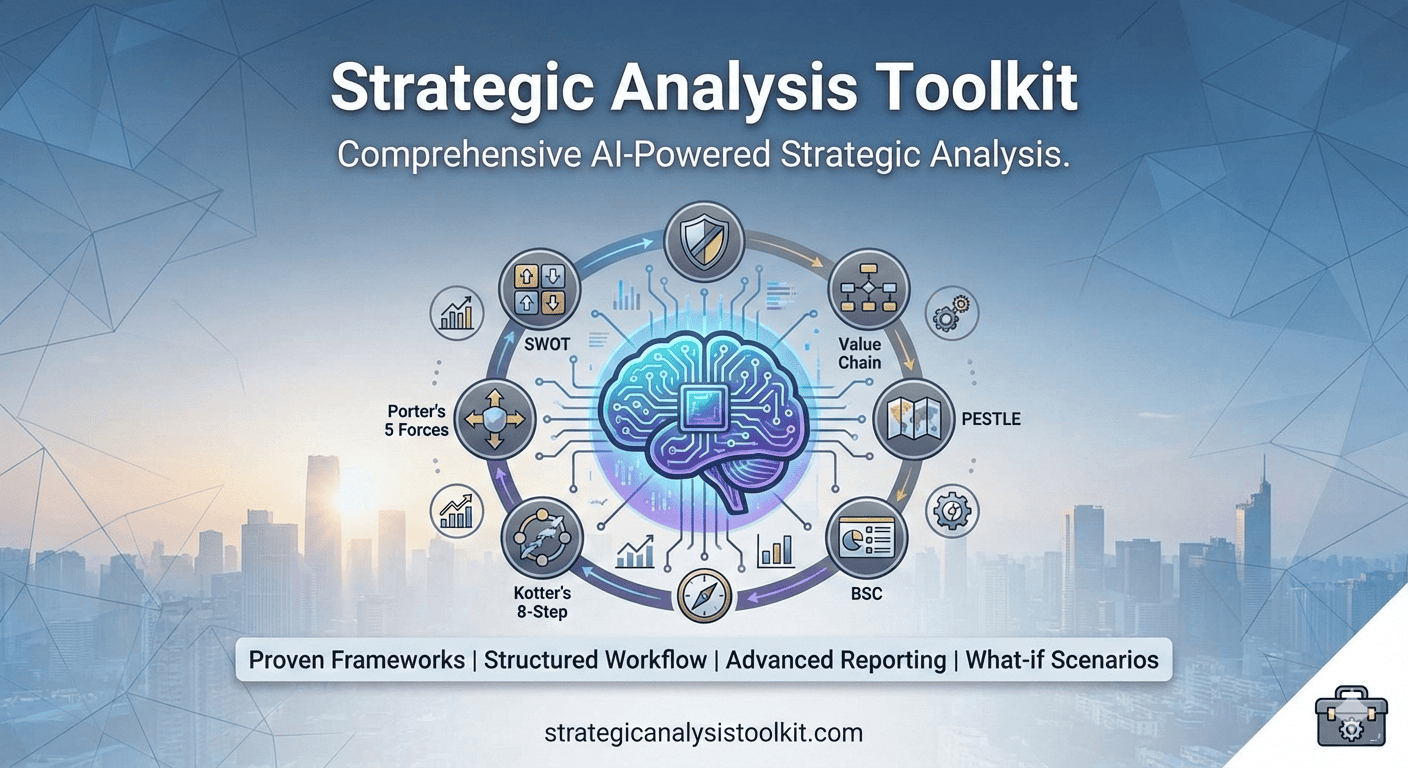
Strategic Analysis Toolkit
GetRiskManager

MealPlanGenius

Go To Local Weather

1
Reply